
Best Electric Car Under 10 Lakh in India — 2026 Buyer's Guide
The 5 best EVs under ₹10 lakh in India for 2026 — Tiago EV, Comet EV, eC3, Punch EV base, e-Vitara. Range, charging, boot, real-world picks.
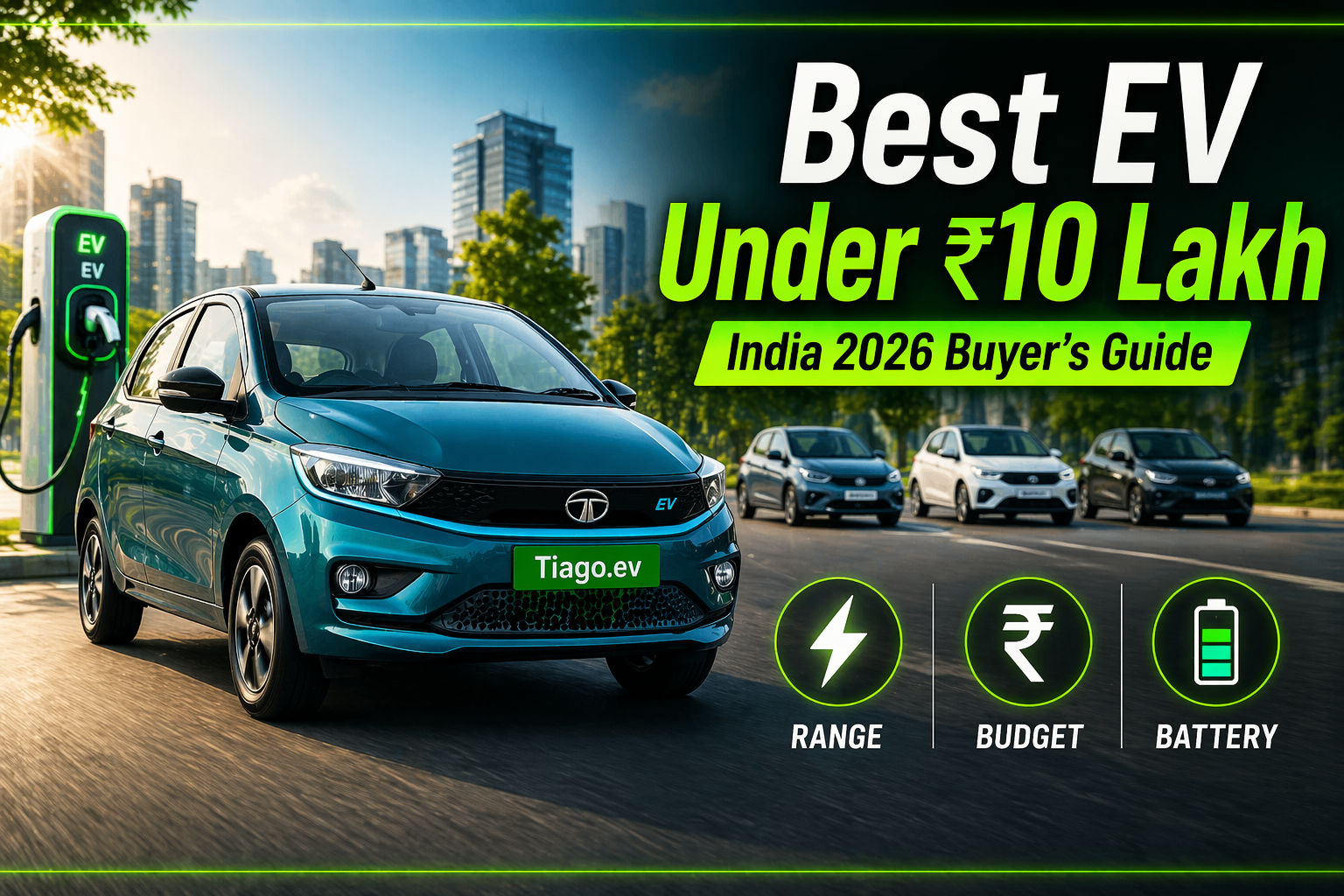

The under-₹10-lakh EV segment is where India's electric revolution will actually happen. Not the ₹25 lakh luxury SUVs — the daily-commute cars priced where a middle-class family genuinely considers them. In 2026, five models fit this bracket, and they're very different animals. This guide ranks them by real-world usability and closes with a decision framework for picking the right one.
The Contenders (Ex-Showroom Under ₹10 Lakh)
- Tata Tiago EV
- MG Comet EV
- Citroen eC3
- Tata Punch EV (base MR trim)
- Upcoming: Maruti e-Vitara base trim (launch mid-2026, expected sub-₹10L in one variant)
Before rankings, the full spec comparison — everything that matters in one table.
Side-by-Side Comparison
| Car | Ex-showroom | ARAI range | Real-world | Fast charge (10–80%) | Boot | Warranty (battery) |
|---|---|---|---|---|---|---|
| Tata Tiago EV (LR) | ₹8.69 L | 315 km | 230–260 km | 57 min (50 kW) | 240 L | 8 yr / 1.6L km |
| MG Comet EV | ₹7.50 L | 230 km | 150–175 km | No DC fast charging | Minimal | 8 yr / 1.2L km |
| Citroen eC3 | ₹9.99 L | 320 km | 240–270 km | 57 min (50 kW) | 315 L | 7 yr / 1.4L km |
| Tata Punch EV MR | ₹9.99 L | 315 km | 230–260 km | 56 min (50 kW) | 366 L | 8 yr / 1.6L km |
| Maruti e-Vitara base (est.) | ~₹10 L | ~250 km (est.) | ~190 km | TBA | ~320 L | TBA |
Caveat: ARAI range is lab-certified. Expect 20–25% less in real Indian traffic, more if you commute in Mumbai/Bangalore summer with AC on full.
Our Ranking (Best First)
1. Tata Punch EV (MR trim) — The Best Overall Pick
At ₹9.99 lakh ex-showroom, the base Punch EV slides in just under the ₹10L cap and gives you everything the segment should: 315 km ARAI range, DC fast charging, 366 L boot, SUV-tall seating position, and access to Tata's 1,000+ service network. Read our full Tata Punch EV review.
- Best for: Families, first-time EV buyers, Tier-2 city buyers.
- Watch out for: MR trim is fabric seats, no sunroof, no auto AC. If you want those features you'll blow past ₹10L.
2. Tata Tiago EV (Long Range)
If you want a hatchback and don't need SUV stance, the Tiago EV is the value play at ₹8.69 lakh. Same battery chemistry as the Punch EV, same fast charging, same service network — in a lighter, more efficient package.
- Best for: City commuters, second-car buyers, narrow-street parking.
- Watch out for: Smaller boot, lower ground clearance on broken roads.
3. Citroen eC3
The dark horse. Citroen's eC3 is genuinely comfortable — its suspension handles Indian roads better than anything else in the segment — and the 315 L boot is usable. Service network is the weakest of the four, though, with fewer than 100 Citroen outlets nationally.
- Best for: Buyers in metros where Citroen has presence, road comfort seekers.
- Watch out for: Sparse service network in Tier-2/3 cities, fewer feature options.
4. MG Comet EV
The cheapest EV on sale in India at ₹7.50 lakh. It's a two-door, four-seater quadricycle-adjacent city runabout — not a real family car. No DC fast charging means you're tied to 7-hour home charges. But as a second car or a short-commute urban scooter-replacement, it's unbeatable on price.
- Best for: Single-person city commute, society compound buyers, sub-50 km/day.
- Watch out for: No fast charging, no highway capability, 2 rear doors is a dealbreaker for families.
5. Maruti e-Vitara (base, upcoming)
Too early to rank definitively, but Maruti's entry will reshape this segment. Expect pricing aggressive enough to put pressure on the Punch EV. If you can wait until mid-2026 and live near a Nexa dealership, this is worth holding out for.
Decision Framework: Which Should You Actually Buy?
Stop reading reviews and answer three questions:
- Daily driving distance?
- Under 30 km/day → MG Comet EV is enough and saves you ₹2 lakh vs the Punch EV.
- 30–80 km/day → Tata Tiago EV or Punch EV MR.
- 80–150 km/day (sales job, daily intercity) → Punch EV MR or step up to Punch EV LR / MG Windsor EV above the ₹10L cap.
- How often do you leave the city?
- Rarely → Comet works.
- Monthly weekend trips → Fast charging is non-negotiable. Rules out the Comet.
- Where do you live?
- Top-6 metro → All options viable.
- Tier-2 city → Tata (Tiago or Punch EV) for the service network alone.
Charging at Home: What You'll Actually Spend
Budget ₹35,000–₹60,000 for a 7.2 kW wallbox with installation (electrician, cable run, RCCB). Most cars come with a 3.3 kW portable charger included, which works but is slow — an overnight full-charge on the Punch EV takes 10 hours on the portable vs 5.5 hours on the wallbox.
Running Cost Math
All five cars cost roughly ₹1.00–1.20 per km to run on home electricity at ₹8/unit. That's one-sixth of an equivalent petrol hatchback at ₹6.50/km. A 12,000 km/year driver saves roughly ₹65,000 a year in fuel alone — the EV pays for the price premium (~₹1.5 lakh over a comparable petrol car) in 2.5 years.
Subsidies to Check Before You Book
Every state rate changes — see the live MeraEV subsidy tracker. Key 2026 rates:
- Delhi: ₹1.5 lakh purchase subsidy + 100% road-tax waiver.
- Maharashtra: 100% road-tax + registration waiver (~₹80,000 saving).
- Gujarat: ₹1.5 lakh purchase subsidy.
- Karnataka: 100% road-tax waiver.
- Tamil Nadu: 100% road-tax + registration waiver.
Where to Buy
Start on the model pages: Tata Punch EV, Tata Tiago EV, Citroen eC3, MG Comet EV. Compare up to three side-by-side on the MeraEV compare tool, and check city availability on Bangalore, Pune, or Hyderabad.
Frequently Asked Questions
What is the cheapest electric car in India in 2026?
The MG Comet EV at ₹7.50 lakh ex-showroom. It's a two-door, four-seater city runabout — best as a second car, not a primary family vehicle.
Which EV under ₹10 lakh has the longest real-world range?
The Citroen eC3 and Tata Tiago EV are tied in practice at around 240–270 km of real-world range. The Punch EV MR is within the same band at 230–260 km.
Can I drive an EV from Delhi to Jaipur on one charge?
Only the Long Range variants of the Tiago EV and Punch EV (and above) have enough real-world range for the 280 km Delhi–Jaipur run with margin. Even then, we'd recommend a 15-minute top-up at a DC fast charger en route. The MG Comet EV cannot make this trip.
Is it worth buying an EV under ₹10 lakh, or should I spend more?
Under ₹10 lakh gives you a capable city EV with fast charging and a real service network (with the Punch EV MR or Tiago EV). If you regularly do 150+ km intercity trips or need a genuinely spacious rear seat, stepping up to the ₹12–15L range makes sense.
Liked this article? Share it with friends